The MRI reference you open at the console
Every protocol with the reason for each sequence. Dynamic studies step by step. Artifacts and their fixes. Safe first checks for common scanner problems, and when to call service. In English and Arabic.
One payment of $15 (about 56 SAR). You get the PDF in two editions and the interactive tool.
One technique, three names
What is inside
Nine sections. Each entry says what the thing is for, how it works, and what happens when you change it.
- 32
Protocols
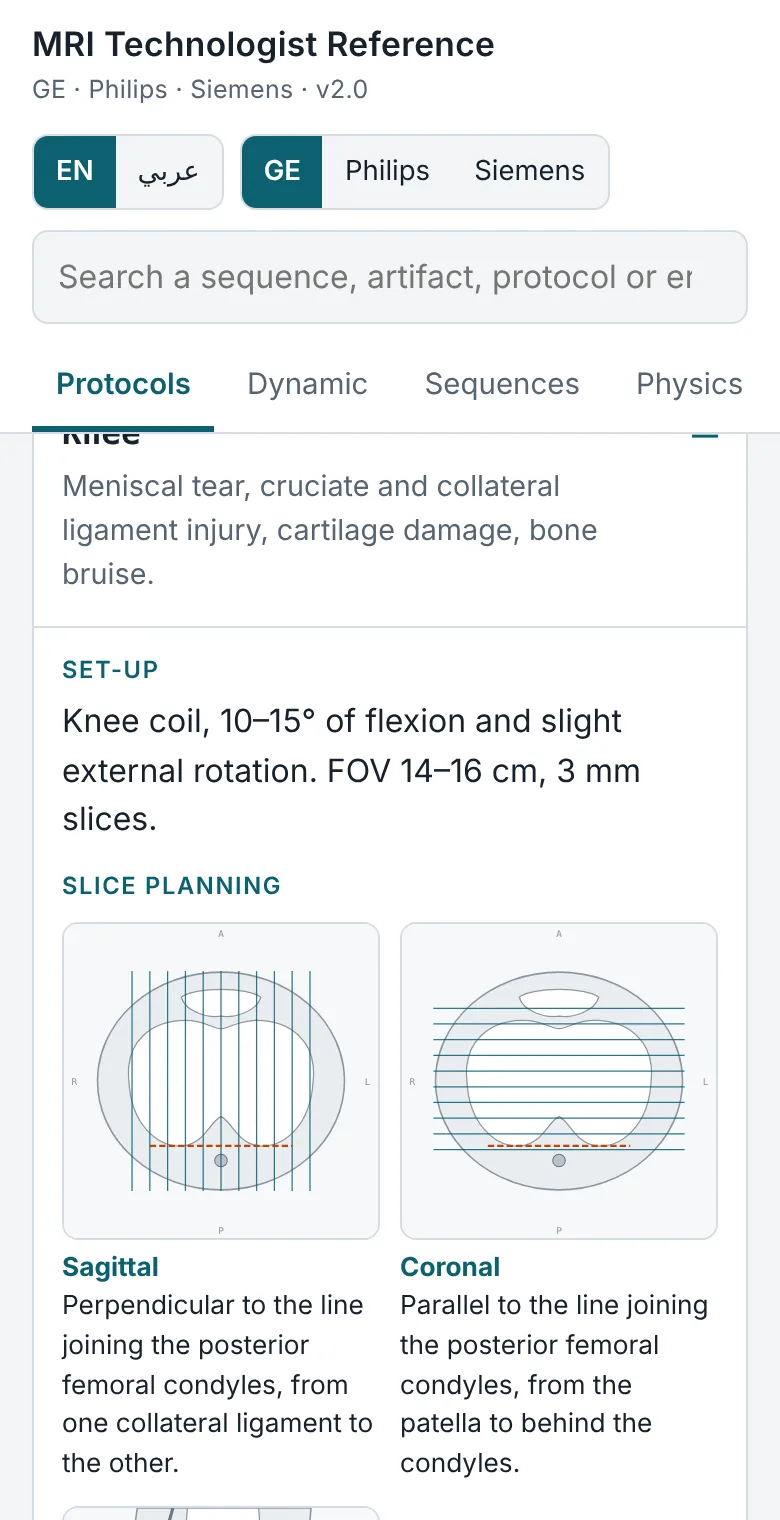
Neuro, spine, musculoskeletal, abdomen and pelvis, breast, cardiac and vascular. Each one gives the indications, the set-up, slice-planning drawings, the sequences with the reason for each, contrast, and practical points.
- 9
Dynamic study timelines
The eight steps from dry run to documentation, how to calculate the start delay, a timeline for each of nine examinations, and eight failure cases with what to do.
- 16
Scanner problems
Likely causes, what to try in order, and when to call service. With the software restart on GE, Siemens and Philips.
- 19
Artifacts
How each one looks, why it happens, how to fix it, and what the fix costs you.
- 17
Sequence guides
What is bright, what the sequence is for, and what can mislead you.
- 55
Vendor names
Sequences, angiography, acceleration and parameter names on GE, Philips and Siemens.
- 18
Parameters
The purpose, how it works, the trade-off when you change it, and a practical tip.
- 8
Concepts in plain words
k-space, weighting, why ghosts follow the phase direction, inversion recovery, diffusion and more.
- 15
Safety and preparation topics
Zones, screening, implants, SAR and burns, quench, pregnancy, gadolinium, and a final check before Zone IV.
Read a page before you pay
Two entries exactly as they appear in the reference.
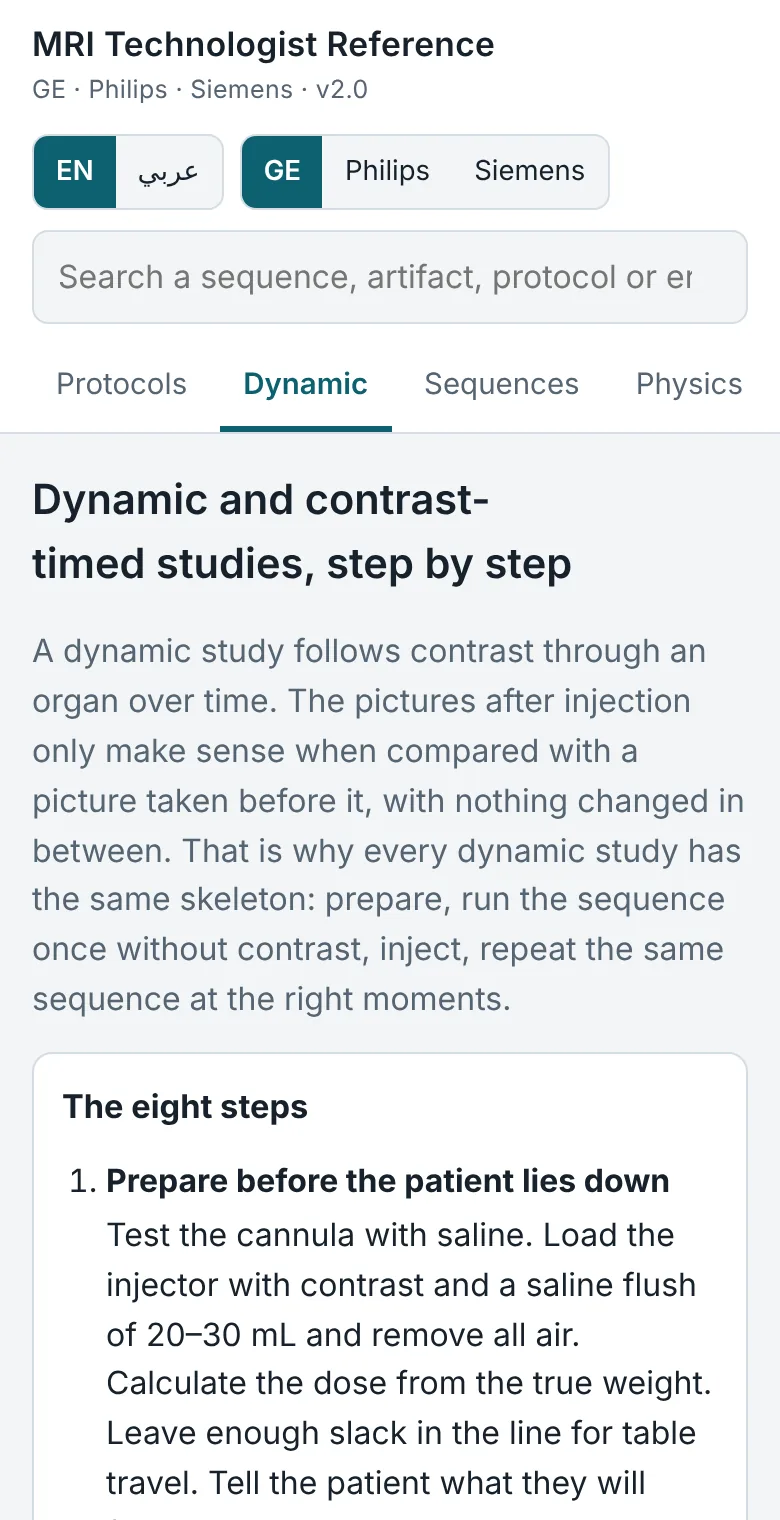
The eight steps
- Prepare before the patient lies down
- Finish everything that contrast would spoil
- Run the dynamic sequence once without contrast: the dry run (mask)
- Fix problems now, then freeze the set-up
- Choose how you will time the scan
- Inject and start the clock together
- Check each phase as it appears
- Finish and document
Start delay = target time − time from scan start to the centre of k-space. Begin the breathing command about 5 seconds before the start.
Example: you want the late arterial phase at 35 s. The scan lasts 16 s with linear ordering, so its centre is at 8 s. Start the scan at 35 − 8 = 27 s and begin the breathing command at about 22 s. With centric ordering the same scan would start at 35 s.
In the reference each step is explained in full, followed by nine examination timelines and eight failure cases.
Fat suppression suppresses water, or does nothing
The scanner set its centre frequency on the fat peak instead of the water peak. This happens where fat dominates (breast, large patients) and where the field is uneven. Fat sits about 220 Hz below water at 1.5 T and about 440 Hz below at 3 T. Silicone gives a third peak next to fat.
- Open manual prescan and look at the spectrum: two peaks, water on the left, fat on the right in the usual display
- Move the cursor to the water peak and accept
- Repeat the shim with the volume on tissue
- If it still fails, switch to Dixon or STIR
Not a service problem unless fat suppression fails on the phantom.
One of 16 scanner problems.
Two formats in one purchase
Interactive tool
- Search every section at once
- Switch the sequence names to your vendor
- English or Arabic with one tap
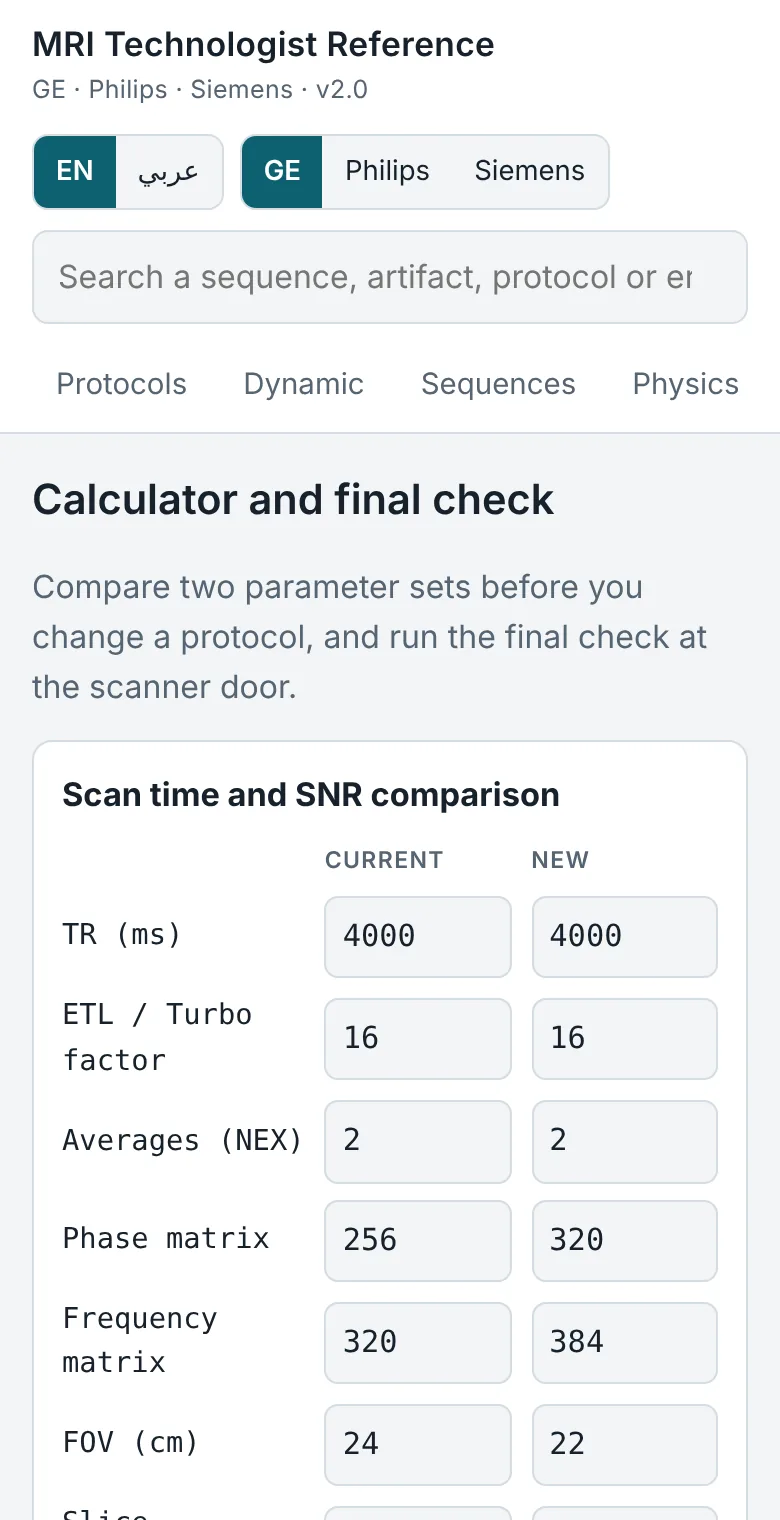
- Compare scan time and SNR before you change a protocol
- Opens in the browser on phone or computer with your license key. Works offline after the first visit
PDF guide
- English edition, 79 pages. Arabic edition, 79 pages
- A4, ready to print for the control room
- The same content as the tool, in reading order
- References listed at the end
Who it is for
- Technologists in their first years who want the reason behind each step
- Technologists moving to a scanner from another vendor
- Students and interns in radiologic technology
- Radiology residents who want to know what the technologist does and why
What it is not
- It does not replace your department's protocols or the radiologist's request
- It is not vendor documentation and not a physics textbook
- It does not clear an implant: always check the manufacturer's conditions
What it was checked against
Version 2.0 was reviewed in November 2026 against published guidance. Where a protocol follows a guideline, the guideline is named under it. The full reference list is at the end of the PDF.
- ACR Manual on MR Safety 2024
- ACR Manual on Contrast Media
- IEC 60601-2-33 Ed. 4
- ASTM F2503
- PI-RADS v2.1
- LI-RADS v2018
- EUSOBI breast MRI
- SCMR 2020
- MAGNIMS–CMSC–NAIMS 2021
- ILAE HARNESS-MRI
- ESGAR rectal 2018
- ESGAR/ESPR 2017
- ASAS–SPARTAN 2024
Protocols are not universal. They differ from one hospital to another and from one radiologist to another, and they change with the scanner, the coil, the software version and the clinical question. What is written here is one common way of doing each examination that agrees with the published guidance listed in the references. It does not have to match your department, and it does not replace your department's approved protocol or the radiologist's request.
Browse the free pages by section
Each section has its own page.
Free protocols
MRI planning and protocols with the reason for every sequence, and dynamic studies step by step.
8 free pages →Artifacts & problems
What each artifact looks like, why it happens and how to fix it, plus common scanner problems.
20 free pages →Sequences & vendor names
How each sequence works and when to use it, with its name on GE, Philips and Siemens.
17 free pages →MR safety
Implants, pacemakers, metal in the body, claustrophobia and sedation: what to check before the patient goes in.
3 free pages →Parameters & concepts
TR, TE, bandwidth, matrix and the other parameters: what each one changes, and the core concepts behind them.
24 free pages →SCFHS exam: 10 free questions
Try a short mixed quiz written to the SRTLE blueprint, with explanations.
Start now →SCFHS exam guide
Number of questions, time, pass score and the weight of each section.
Read →Pricing
Two separate products. One-time payment each, no subscription. Buy one or both.
MRI Technologist Reference
- 32 protocols with planning images and the reason for every sequence
- Dynamic study timelines, artifacts, scanner problems, safety
- GE, Philips and Siemens names
- PDF in Arabic and English + interactive tool
SCFHS exam practice bank (radiologic technologist)
- 200 original questions with explanations
- Written to the published SRTLE blueprint weights
- Timed web mock exam: 2 × 100 questions, 120 min each, score by section
- Practice by section + PDF
Not an official SCFHS or Prometric product. Original questions, not from the real exam.
Questions
Which language is it in?
Both. You get an English edition and an Arabic edition of the PDF, and the tool switches between them. Technical terms stay in English in both, as they appear on the scanner.
Is this official material from GE, Philips or Siemens?
No. It is an independent reference. For anything that depends on your software version, the operator manual of your scanner comes first.
Will the protocols match my hospital?
Not necessarily. Protocols differ between hospitals and between radiologists. The reference gives one common way of doing each examination and the reason behind each sequence, so you understand your own protocol better.
Does it cover 3 T?
Parameter values are typical starting points at 1.5 T. Where 3 T behaves differently, the text says so, and one section compares 1.5 T with 3 T.
How do I receive it?
Right after payment you get the two PDF files, the link to the interactive tool and your license key. The same page is also sent to your email.
What if I find a mistake?
Tell me and I will check it against the source and correct it. Buyers get the corrected files of version 2 at no cost.
Can I get a refund?
The files are digital, so a purchase cannot be returned once they are downloaded. Read the free sample first. If a file does not open or is damaged, write to us within 7 days and we fix it or refund you.
Corrections and questions: